
Yes, it is possible to change your military job after enlisting—but you cannot simply pick a new one whenever you want. Every branch has a process for moving qualified members into another career field. Approval depends on openings, your current job’s staffing needs, eligibility, training capacity, and sometimes a new service obligation, meaning additional time you agree to serve.
Your current job is also called an occupational specialty. The Army and Marine Corps call it a military occupational specialty (MOS); the Navy and Coast Guard use ratings, while the Air Force uses Air Force Specialty Codes (AFSCs) and the Space Force uses Space Force Specialty Codes (SFSCs). The terminology differs, but the same practical question applies: Does your branch have an approved path from your current position into the one you want?
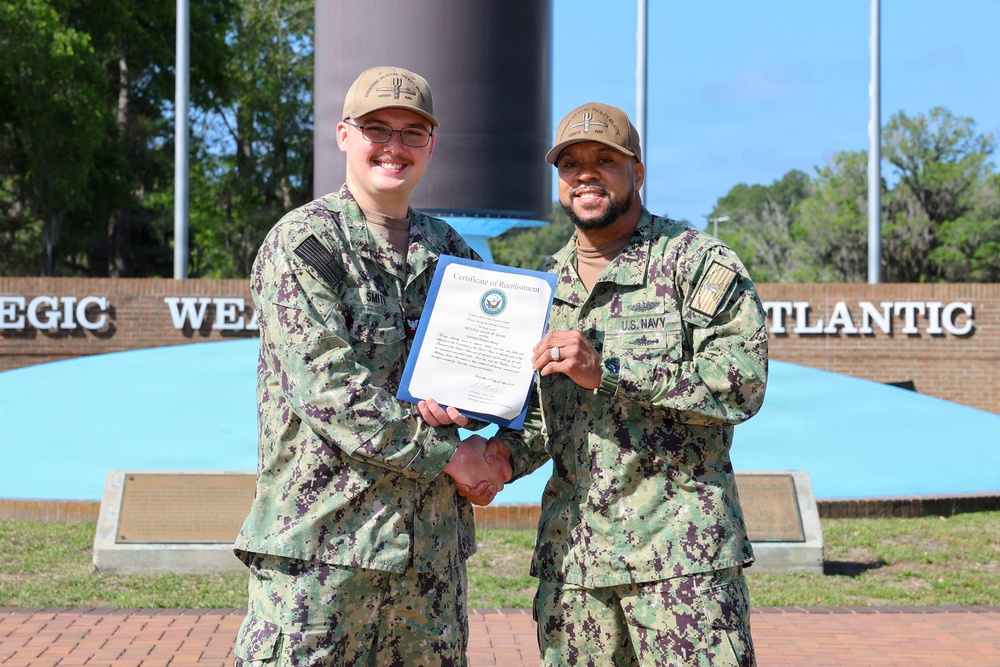
Photo by Ashley Berumen, Strategic Weapons Facility Atlantic. Original photograph and rights information at DVIDS.
In this guide
- When switching jobs is possible
- How each branch handles it
- What you may have to qualify for
- A practical way to request the change
- What happens if the request is denied
When can you actually switch military jobs?
There are usually three routes:
- Voluntary career change. You apply to enter another specialty when your branch has openings and you meet the requirements. The Army commonly calls this reclassification; the Air Force calls many such changes retraining; the Navy uses rating conversion; and the Marine Corps uses lateral moves.
- Reenlistment-linked change. An approved new job may be part of a continued-service agreement. That can mean new training and an additional service commitment.
- Service-directed change. The military can require or offer a move into another specialty because of staffing, medical eligibility, force restructuring, or other authorized reasons.
Being unhappy in your current job, by itself, does not guarantee approval. And a job that is available to brand-new recruits may not be open to experienced members who want to transfer into it.
How changing military jobs differs by branch
| Branch | Common process | The first place to check |
|---|---|---|
| Army | MOS reclassification, sometimes in connection with reenlistment | Unit career counselor and current Army Human Resources Command in/out calls |
| Navy | Rating conversion, with some conversions requiring a school or application package | Command career counselor and MyNavy HR conversion instructions |
| Marine Corps | Enlisted lateral move into a new MOS; officer moves use separate programs | Unit career counselor and current Marine Corps manpower guidance |
| Air Force | First-term or career-airman retraining into eligible specialties | Development advisor, myFSS, and current retraining advisory |
| Space Force | Specialty changes handled under applicable personnel and retraining guidance; entry or transfer programs are separate matters | Guardian leadership and official personnel management channels |
| Coast Guard | Rating change through approved pathways, sometimes requiring an A-school | Command career advisor or personnel office and current Coast Guard rules |
Army: reclassification depends on openings in both specialties
Army Human Resources Command publishes in/out calls—a staffing tool that identifies which occupations may release Soldiers and which need them. Calls can change at the MOS and grade level. A Soldier might meet every personal qualification but still face a staffing restriction in the current MOS, or there may be no school seat in the requested one. Army Human Resources Command’s reclassification guidance directs Soldiers to their career counselor first. The Army retention site also explains voluntary and mandatory reclassification.
Navy: a rating conversion is a formal application
The Navy distinguishes conversions that need a training school, those that require an application package, and other specific routes. Published instructions describe required records, career-manager review, and submission timing. Not every rating is open for conversion at all times. Start with the MyNavy HR conversions page and your command career counselor.
Marine Corps: lateral moves are tied to retention and manpower plans
The Marine Corps publishes lateral-move opportunities by fiscal year. Its enlisted lateral-move program lists selected fields, eligibility criteria, and applicant guidance; its retention page explains annual application windows. Some competitive fields demand additional screening, so meeting a test-score cutoff alone isn’t enough.
Air Force: retraining has eligibility windows and specialty requirements
The Air Force has retraining pathways for first-term members and for career Airmen. Its published rules require members to meet the gaining specialty’s entry standards and applicable service requirements; the availability of open fields is not fixed year-round. Talk to your installation development advisor and consult Air Force Personnel Center retraining guidance and Department of the Air Force Manual 36-2100. A recent Air Force career event also emphasizes checking eligibility and actual vacancies before applying.
Space Force: don’t confuse changing specialties with transferring services
The Space Force has its own specialty and personnel-management system. Its retraining rules appear within Department of the Air Force guidance, but an internal Guardian specialty change is not the same thing as applying to transfer into the Space Force from another service. The Space Force transfer program has its own eligibility and selection rules. Current Guardian specialty-change opportunities are best confirmed through leadership and personnel channels rather than a generic job list.
Coast Guard: rating changes exist, with different active and reserve procedures
The Coast Guard has pathways for changing ratings, including requests that can involve Class A school, the formal initial school for many ratings. Its official career-training page links to rating requirements, and its reserve lateral-change guidance describes a specific reserve process. Reserve instructions should not automatically be assumed to apply to active duty.
What do you need to qualify for a new job?
Your branch will normally consider several things together. Useful questions to ask include:
- Is the new specialty taking people at my grade? A field may have vacancies for recruits but no room for your current rank.
- Can my current field release me? This is especially important in understaffed jobs.
- Do I meet the testing standard? An existing ASVAB score or new qualification testing may be needed for certain occupations.
- Can I pass the required screening? Medical, physical, conduct, background and other standards can be career-specific.
- Is retraining available? Changing jobs often means completing a new training pipeline rather than immediately reporting to a new team.
- Will I owe more service time? New training, a reenlistment agreement, or a specialty program may carry an additional service commitment.
If a new specialty requires stronger academic test scores, take our ASVAB practice test and see where you stand, then use the study planner to work on weaker subjects. Practice scores help with preparation but do not replace your official qualification record.
How to request a different military job
Step 1: Name the exact career field. Find the current official code and learn what the job involves, where people typically serve, and whether its training is realistic for your situation. A job name on a recruiting site isn’t enough to establish in-service availability.
Step 2: Talk to the person who handles career changes. In different branches this may be a career counselor, development advisor, assignments office, or personnel specialist. Ask for the current transfer, conversion or retraining rules for your rank and contract status.
Step 3: Compare the requirements with your records. Confirm testing, medical, security, fitness, time-in-service and training prerequisites. The sooner you find a disqualifier, the sooner you can ask whether there is a legitimate way to resolve it.
Step 4: Check timing and commitments. Some programs open only during particular windows or require reenlistment. Ask what will happen to your current contract and whether a new obligation starts upon acceptance or training.
Step 5: Submit the official application and wait for written approval. Don’t assume your job has changed because someone says you are a good candidate. Keep copies of the submitted package, correspondence and any signed agreement.
What if the military denies your request?
A denial usually means you remain in your current career field and must continue meeting your existing obligations. It does not automatically cancel a contract or give you permission to separate early. Find out whether the problem was your eligibility, current-job staffing, the gaining specialty’s quotas, application timing, or an incomplete package.
Some issues can be addressed later—for example, improving a test score, gaining a required qualification, or applying during the next window. Others may mean the career change isn’t practical during this enlistment. Ask for the next realistic opportunity, not a promise that the decision will reverse.
Do not make a permanent decision based on rumors about an automatic switch after basic training. Read your enlistment contract and related documents and understand the difference between an initial job commitment and a possible future transfer.
The bottom line
Yes, you can sometimes change your job after enlisting. But the military has to approve the change, and your preferences are only one part of the decision. Start with the current branch-specific process, confirm there is a vacancy for someone in your situation, and ask exactly what additional training and service time the move would require.
Official sources
- Army Human Resources Command — Reenlistment and Reclassification IN/OUT Calls
- Army Retention — Reclassification
- MyNavy HR — Enlisted Rating Conversions
- Marine Corps Manpower — Enlisted Lateral Move Opportunities
- Marine Corps Manpower — First-Term and FY27 Retention Windows
- Department of the Air Force — Manual 36-2100 (2025)
- Air Force Personnel Center — Retention and Retraining
- Space Force — Transfer Programs
- Coast Guard — Enlisted Career Training
- Coast Guard — Reserve Lateral Change in Rating
- DVIDS — Navy rate conversion photo by Ashley Berumen